
'%3e%3cpath%20fill-rule='evenodd'%20clip-rule='evenodd'%20d='M12%205.54358C14.7301%205.54358%2017.0344%207.36702%2017.7613%209.86248C19.6535%2010.5747%2021%2012.4019%2021%2014.5436C21%2017.305%2018.7614%2019.5436%2016%2019.5436H7C4.79086%2019.5436%203%2017.7527%203%2015.5436C3%2013.6789%204.27588%2012.1123%206.00225%2011.669L6%2011.5436C6%208.22987%208.68629%205.54358%2012%205.54358Z'%20stroke='%23333333'%20stroke-opacity='0.9'%20style='stroke:%23333333;stroke-opacity:0.9;'%20stroke-width='1.5'%20stroke-linejoin='round'/%3e%3cpath%20d='M11.75%209.54358C12.1642%209.54358%2012.5%209.87937%2012.5%2010.2936V14.0436H14.25C14.6642%2014.0436%2015%2014.3794%2015%2014.7936C15%2015.2078%2014.6642%2015.5436%2014.25%2015.5436H11.75C11.3358%2015.5436%2011%2015.2078%2011%2014.7936V10.2936C11%209.87937%2011.3358%209.54358%2011.75%209.54358Z'%20fill='%23333333'%20fill-opacity='0.9'%20style='fill:%23333333;fill-opacity:0.9;'/%3e%3c/g%3e%3cdefs%3e%3cclipPath%20id='clip0_4593_22613'%3e%3crect%20width='24'%20height='24'%20fill='%23333333'%20style='fill:%23333333;fill-opacity:1;'%20transform='translate(0%200.543579)'/%3e%3c/clipPath%3e%3c/defs%3e%3c/svg%3e)

搜索 「彼得·科普利」,找到 5 部影片
更多精彩内容,请安装客户端 >下载APP查看更多 > 电影
电影雾都孤儿
巴内·克拉克 / 杰里米·斯威夫特 / 伊恩·麦克尼斯 / 理查德·杜顿 / 蒂莫西·贝特森 / 安迪·德拉图尔 / 约瑟夫·特雷曼 / 彼得·科普利 / 约翰·内特尔顿 / 托尼·诺布尔 / Michael Heath / 特蕾莎·邱吉尔 / 克里斯·奥弗顿 / 杰拉德·霍兰
19世纪30年代,英国。弃婴奥立弗·特维斯特在教区孤儿院长大。他既不会偷奸耍滑,也不会阿谀奉承,每天从事繁重的体力劳动。因为终日衣不蔽体食不果腹,天性善良的奥立弗被孤儿院的孩子们抽签选中为要求增加食物的代言人。他战战兢兢挺身而出拿着残破的汤碗,向厨师问道:“先生,能否再多给一点点?”此言一出,立刻引起了孤儿院管理层的骚乱,大惊失色的管事决定撵走这个造反的隐患。 成为众矢之的的奥立弗先是险些成为打扫烟囱的小工,后来又在棺材店里当学徒被年长学徒妒嫉和诬陷险遭老板毒打。悲愤填胸的小奥立弗星夜出走,一连7天7夜,来到了雾都伦敦。 举目无亲,饥寒交迫,绝望中奥立弗却又辗转落入了在伦敦横行的小偷童党之手,但本性善良的奥利弗不欲加入偷窃行为,幸好在缘份安排下,他遇上了善良而富有的老作家,被收为养子,可惜命运弄人,童党老头目得悉他在富裕家庭生活,强行掳带奥利弗,更利用他熟识作家家中环境,计划进行大偷窃,奥利弗反抗误中枪伤,更险些被误会成背叛养父的小贼,而小偷党的头领亦因事败而迁怒于奥利弗,本性善良的奥利弗,在面对生死攸关的同时,如何洗脱罪名?
 电影
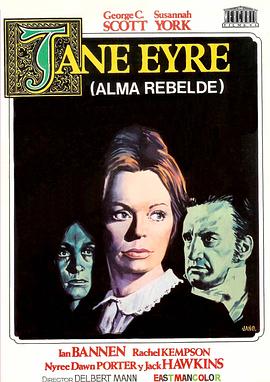
电影简爱1970
乔治·C·斯科特 / 苏珊娜·约克 / 伊安·邦纳 / 杰克·霍金斯 / 奈里·唐·波特 / 瑞切尔·凯姆普森 / 肯尼思·格里菲思 / 彼得·科普利 / 克莱夫·莫顿 / 范妮·罗 / Susan Lawe / 安格哈拉德·瑞丝 / 卡尔·伯纳德 / 娜恩·芒罗
父母早亡的简爱(苏珊娜·约克 Susannah York 饰)寄住在舅舅家,舅舅病逝后,她受尽舅妈的歧视和虐待,最终被送进孤儿院。教规严厉的孤儿院让简爱继续受到精神和肉体的摧残,为了离开这里,她登了广告去谋求家庭教师职位。桑菲尔德庄园聘用她作男主人罗切斯特先生(乔治·C·斯科特 George C. Scott 饰)女儿的家庭教师。罗切斯特先生长年在外,空旷的房子阴森悚然。当脾气怪异的罗切斯特先生回来后,他对待简爱的态度时好时坏,但很显然他被清新独特的简爱所吸引,简爱也在与他的多次接触中渐渐爱上了他。在一次盛大家庭宴会中,罗切斯特向她求婚,简爱答应了他。正在婚礼举行时,有人指出罗切斯特早已结婚,古堡顶楼小屋里的疯女人正是他的妻子。伤心失望的简爱离开了庄园,历尽磨难寻找新出路,最终在牧师约翰的帮助下找到了一个乡村教师的职业。当牧师约翰向简爱求婚时,她依然无法忘怀罗切斯特,便拒绝了约翰,立刻赶回桑菲尔德庄园,却发现庄园已被烧成废墟……
 电影
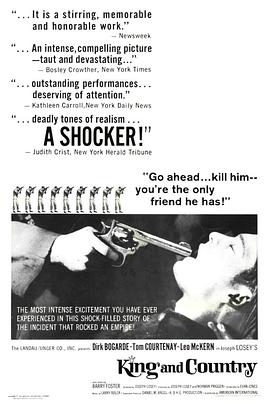
电影国王与国家
德克·博加德 / 汤姆·康特奈 / 莱奥·麦凯恩 / 巴里·福斯特 / 彼得·科普利 / 詹姆斯·维利尔斯 / 杰瑞米·斯宾塞 / Barry Justice / Vivian Matalon / 基思·巴克利 / James Hunter / Larry Taylor
The last time Britain was a major force in world cinema was in the 1960s; a documentary of a few years back on the subject was entitled 'Hollywood UK'. This was the era of the Kitchen Sink, social realism, angry young men; above all, the theatrical. And yet, ironically, the best British films of the decade were made by two Americans, Richard Lester and Joseph Losey, who largely stayed clear of the period's more typical subject matter, which, like all attempts at greater realism, now seems curiously archaic. 'King and Country', though, seems to be the Losey film that tries to belong to its era. Like 'Look Back in Anger' and 'A Taste of Honey', it is based on a play, and often seems cumbersomely theatrical. Like 'Loneliness of the long distance runner', its hero is an exploited, reluctantly transgressive working class lad played by Tom Courtenay. Like (the admittedly brilliant) 'Charge of the Light Brigade', it is a horrified, near-farcical (though humourless) look at the horrors of war, most particularly its gaping class injustices. Private Hamp is a young volunteer soldier at Pachendaele, having served three years at the front, who is court-martialled for desertion. Increasingly terrorised by the inhuman pointlessness of trench warfare, the speedy, grisly, violent deaths of his comrades and the medieval, rat-infested conditions of his trench, he claims to have emerged dazed from one gruesome attack and decided to walk home, to England. He is defended by the archetypal British officer, Captain Hargreaves, who professes disdain for the man's cowardice, but must do his duty. He attempts to spin a defence on the grounds of madness, but the upper-crust officers have heard it all before. This is a very nice, duly horrifying, liberal-handwringing, middle-class play. It panders to all the cliches of the Great War - the disgraceful working-class massacre, while the officers sup whiskey (Haig!) - figured in some charmingly obvious symbolism: Hargreaves throwing a dying cigarette in the mud; Hamp hysterically playing blind man's buff. The sets are picturesquely grim, medieval, a modern inferno, as these men lie trapped in a never-ending, subterranean labyrinth, lit by hellish fires, with rats for company and the constant sound of shells and gunfire reminding them of the outside world. The play, in a very middle-class way, is not really about the working class at all - Hamp is more of a symbol, an essence, lying in the dark, desolately playing his harmonica, a note of humanity in a score of inhumanity. He doesn't develop as a character. The play is really about Hargreaves, his realisation of the shabby inadequacy of notions like duty. He develops. This realisation sends him to drink (tastier than dying!). Like his prole subordinates, he falls in the mud, just as Hamp is said to have done; he even says to his superior 'We are all murderers'. This is all very effective, if not much of a development of RC Sherriff's creaky 'Journey's End', filmed by James Whale in 1930. Its earnestness and verbosity may seem a little stilted in the age of 'Paths of Glory' and 'Dr. Strangelove'; we may feel that 'Blackadder goes forth' is a truer representation of the Great War. But what I have described is not the film Losey has made. He is too sophisticated and canny an intellectual for that. The film opens with a lingering pan over one of those monumental War memorials you see all over Britain (and presumably Europe), as if to say Losey is going to question the received ideas of this statue, the human cost. But what he's really questioning is this play, and its woeful inadequacy to represent the manifold complexities of the War. This is Brechtian filmmaking at its most subtle. We are constantly made aware of the artifice of the film, the theatrical - the stilted dialogue is spoken with deliberate stiffness; theatrical rituals are emphasised (the initial interrogation; the court scene, where actors literally tread the boards, enunciating the predictable speeches; the mirror-play put on by the hysterical soldiers and the rats; the religious ceremony; the horrible farce of the execution). Proscenium arches are made prominent, audiences observe events. This is a play that would seek to contain, humanise, explain the Great War. This is a hopeless task, as Losey's provisional apparatus explains, 'real' photographs of harrowing detritus fading from the screen as if even these are not enough to convey the War, never mind a well-made, bourgeois play. Losey's vision may be apocalyptic - it questions the possibility of representation at all - the various tags of poetry quoted make no impact on hard men men who rattled them off when young; the Shakespearean duality of 'noble' drama commented on by 'low' comedy, effects no transcendence, no greater insight. Losey's camerawork and composition repeatedly breaks our involvement with the drama, any wish we might have for manly sentimentality; in one remarkable scene an officer takes an Aubrey Beardsley book from the cameraman! This idea of the theatrical evidently mirrors the rigid class 'roles' played by the main characters (Hamp's father and grandfather were cobblers too; presumably Hargreaves' were always Sandhurst cadets). Losey also takes a sideswipe at the kitchen sink project, by using its tools - history has borne him out.
 影视
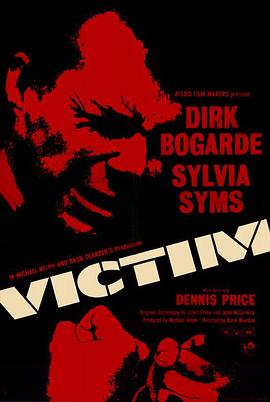
影视受害者1961
德克·博加德 / 西尔维娅·西姆斯 / 丹尼斯·普莱斯 / 安东尼·尼科尔斯 / 彼得·科普利 / 诺曼·伯德 / 皮特·麦克恩里 / 唐纳德·丘吉尔 / 德伦·内斯比特 / John Barrie / 约翰·凯尼 / Alan MacNaughton / 奈杰尔·斯托克 / Frank Pettitt
同志电影史最重要的作品之一,它不只是第一部直接道出‘同性恋’字眼的英语片,更勇于碰触性取向成为被抹黑、勒索和恐惧的社会现实。在同志电影多如过江之鲫的今日,它的直陈无碍更显难得。英国红星狄鲍嘉也在突破形象后,日后毫无忌惮地演出维斯康堤、法斯宾达的电影。当年囿于英国电检而消失的十分钟,也将以全新数位修复拷贝,忠实重现。
 电影
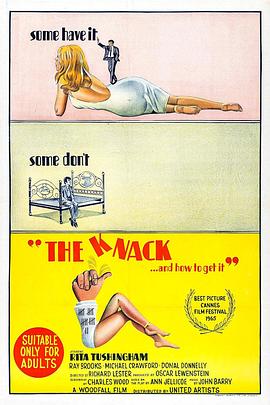
电影诀窍
丽塔·塔欣厄姆 / 雷·布鲁克斯 / 迈克尔·克劳福德 / 敦尔·当纳利 / William Dexter / Charles Dyer / Margot Thomas / 约翰·布鲁塞尔 / Helen Lennox / Wensley Pithey / Edgar Wreford / Frank Sieman / Bruce Lacey / George Chisholm
科林(迈克尔·克劳福德 Michael Crawford饰)是一个个性非常腼腆的男人,向来没有什么女人缘,这和他的房客托伦(雷·布鲁克斯 Ray Brooks 饰)简直有着天壤之别。托伦不仅拥有英俊的外表,还有一套他自创的浑然天成的御女奇招,科林眼看着一个又有一个单纯天真的女孩落入托伦编制的情网之中。虽然嘴上骂着托伦的薄情寡义,但实际上,所有人都能看得出来,科林非常的羡慕托伦。<br>一天,科林邂逅了一位名叫南希(丽塔·塔欣厄姆 Rita Tushingham 饰)的基督徒,两人相谈甚欢,科林随即邀请南希去家里做客。哪知道好死不死的,托伦出现了。南希晕倒了,当她从昏厥中清醒过来时,发现自己已经失去了处子之身,她认为这一切都是科林干的。